

Katelyn Matias
Registered Psychotherapist · CRPO #10340
Adults and couples navigating anxiety, trauma, relationships, fertility, pregnancy, or postpartum concerns.
Languages: English.
Treatments · Couples therapy
In-person couples therapy in Mississauga and online across Ontario for committed partnerships. Attachment-based and EFT-informed, focused on the dynamic between you, not on assigning blame.
Couples sessions: $200 for 50 minutes or $290 for 80 minutes.
Choose a couples consultation time in Jane. Both partners are welcome.

Who offers this
Registered Psychotherapist · CRPO #10340
Adults and couples navigating anxiety, trauma, relationships, fertility, pregnancy, or postpartum concerns.
Languages: English.
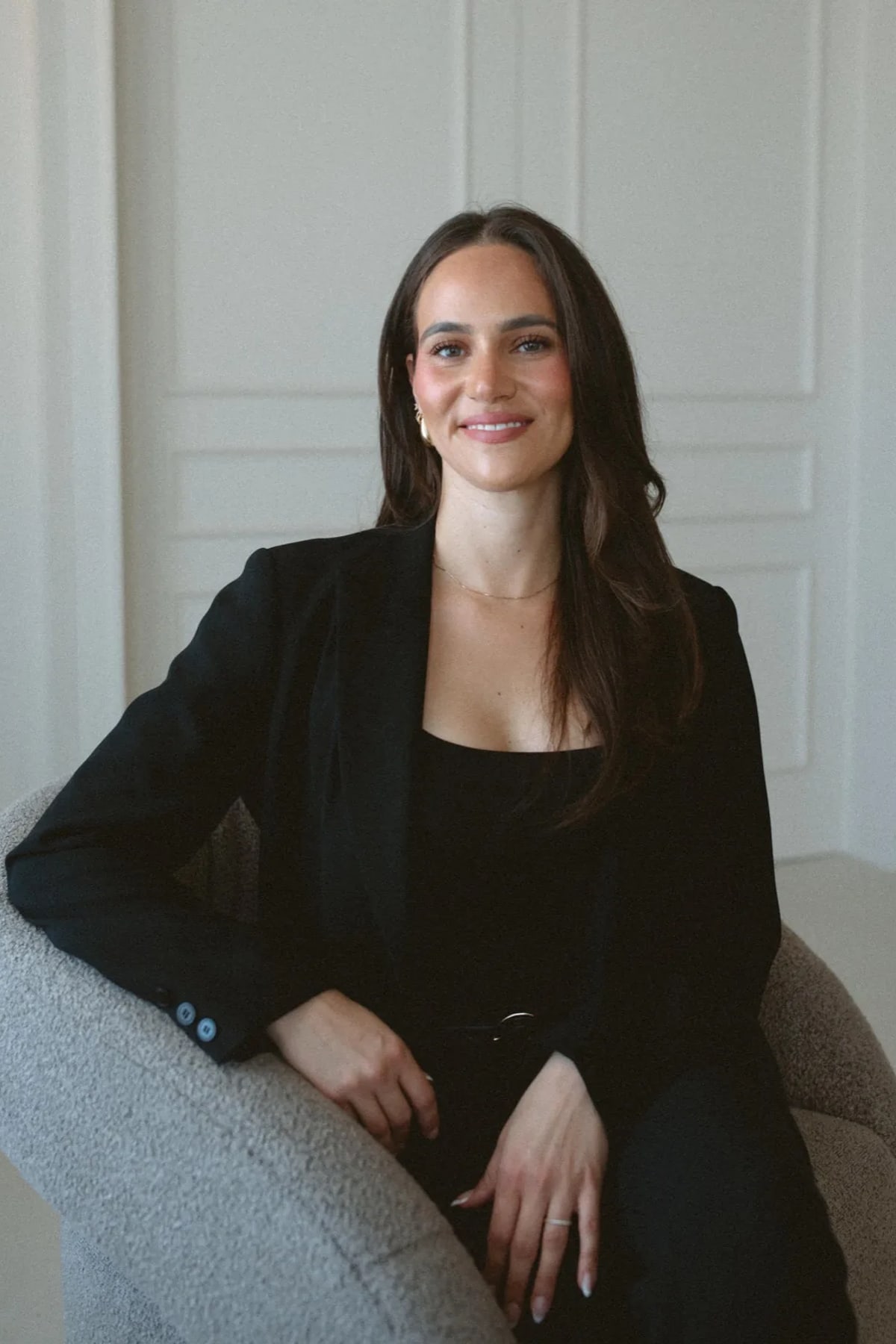
Registered Psychotherapist (Qualifying) · CRPO #19387
Older teens (18+), adults and couples seeking affirming support for anxiety, burnout, trauma, relationships, life transitions, ADHD, or neurodivergence.
Languages: English.

Registered Psychotherapist (Qualifying) · CRPO #21595
Children, preteens, teens, adults, couples and families navigating anxiety, emotional regulation, self-esteem, identity, relationships, life transitions, or past experiences. Ask about the minimum age and family-session format.
Languages: English and Farsi/Persian.

Registered Psychotherapist (Qualifying) · CRPO #20325
Individual and couples therapy for teens and adults, including autistic teens and adults, navigating anxiety, stress, self-criticism, relationship and family concerns, grief, self-esteem, and life transitions, in English, Gujarati, or Hindi.
Languages: English, Gujarati and Hindi.

Registered Psychotherapist (Qualifying) · CRPO #18172
Individual and couples therapy for teens and adults navigating anxiety, trauma, relationship patterns, grief, rejection sensitivity, self-esteem, or life transitions.
Languages: English.

Registered Psychotherapist (Qualifying) · CRPO #20331
Individual, couples, and family therapy, including children, teens, and adults navigating anxiety, depression, trauma, OCD, neurodivergence, relationships, or life transitions.
Languages: English, Farsi/Persian, Hindi and Urdu.

Registered Psychotherapist (Qualifying) · CRPO #22601
Online couples therapy, plus individual therapy for teens and adults experiencing anxiety, depression, emotional regulation concerns, ADHD, or low self-esteem.
Languages: English, Russian and Ukrainian.
Couples therapy at Anchor & Bloom is in-person psychotherapy in Mississauga and online across Ontario for committed partnerships. Some people search for it as marriage counselling or relationship counselling; the work is the same. It is attachment-based and informed by Emotionally Focused Therapy (EFT) for couples, with room for the body and the patterns each partner brings from earlier in life.
We work with married, common-law, dating, queer, polyamorous, and otherwise non-traditional partnerships. The structure of your relationship is not the question. The patterns between you are.
How therapy helps
Through couples therapy, couples can:
What couples bring in
The same fight on repeat. Conversations that escalate before they start, or never start at all. Words that land sideways. A growing sense that you do not speak the same language anymore, even on small things.
The slow drift. Living parallel lives under the same roof. Knowing you love each other and not feeling it the way you used to. Roommates with a shared calendar.
The moments that broke trust in a way you have not fully recovered from. A partner who was not there when it counted. A response that landed as proof you are alone in this.
The work after an affair, emotional or physical, when both partners have chosen to try. This work is slow, structured, and held with care. We are honest about what it asks of both of you.
Pursue and withdraw. Criticize and defend. Escalate and shut down. The choreography of a fight that you both know by heart and neither of you can stop in the moment.
Disagreements about discipline, screens, schedule, school, extended family. Two people with different histories trying to raise the same children and feeling unsupported by each other.
Mismatched desire. The loss of physical closeness after kids, illness, or stress. Working through pain, shame, or grief around sex. Rebuilding intimacy that has gone quiet.
New parents adjusting to a relationship that no longer looks like it did. Empty-nest couples meeting each other again after years of parenting. Retirement, relocation, caregiving for aging parents.
When one of you has been carrying the work of the relationship and the other is just arriving to the conversation. The asymmetry itself is workable. The asymmetry left alone is not.
Engaged or seriously committed couples who want to do the unglamorous work before the wedding. Money, family, sex, kids, conflict style. The conversations that are harder to start once you are already married.
The relational toll of trying, of loss, of medical decisions, of feeling differently about a path forward. Often paired with our fertility & postpartum work.
When ADHD, autism, or other neurodivergent wiring is part of the dynamic. Translating between two nervous systems without one of you being the patient and the other the manager.
The frame
In Emotionally Focused Therapy for couples, the core idea is simple and slightly relieving: the enemy is not your partner. The enemy is the cycle. The cycle is the predictable choreography of your worst conversations. One partner pursues, raises the volume, asks for more. The other withdraws, goes quiet, retreats to the other room. Or one criticizes, names what is wrong, lists the evidence. The other defends, justifies, or shuts the conversation down. The shape changes. The cycle is recognizable within the first few sessions.
The cycle is not a character flaw. It is two attachment systems doing what they learned to do long before this relationship. Underneath the pursuit is almost always a fear of not mattering. Underneath the withdrawal is almost always a fear of failing the person you love. Both partners are reaching for connection. Both are getting the opposite of what they need.
In session, the work is to slow the cycle down enough to see it. To externalize it (to put it on the table between you instead of inside one of you) so you can both look at it together. Over time, you start to catch the cycle in the moment. Then, eventually, before it starts. That shift is the heart of the work.
This frame comes from Sue Johnson's lineage and the EFT model developed at the International Centre for Excellence in EFT. It is one of the most well-researched approaches to couples therapy in the field.
How sessions are structured
Couples therapy at Anchor & Bloom moves through phases. The pace is yours, and not every couple needs every phase, but the shape below is what an EFT-informed course of work tends to look like. We are describing it here so you have a map, not a script.
These phases are illustrative, not prescriptive. Some couples move through them in the order above. Some loop back. Some need only the first two phases and that is enough. We talk about pacing openly, in the room, as we go.
Scope of work
We work with:
We are honest about what is outside our scope:
The modalities, in plain terms
Couples therapy at Anchor & Bloom is integrative. EFT is the spine of the work, with Gottman method research, attachment theory, and polyvagal-informed pacing woven through. Here is how each actually shows up in a session.
Emotionally Focused Therapy (EFT). This is the emotional core of the work. EFT treats the bond between you as the primary unit of attention. Sessions slow down the moments where you misfire with each other so we can hear what each of you was actually reaching for underneath the argument. The goal is not to solve the disagreement on the table. It is to change the way you turn toward each other when things get hard. Most couples notice EFT first as a change in how a fight ends, then as a change in how it starts.
Gottman-informed work. John and Julie Gottman spent decades watching couples in a lab and identifying which patterns predict relationships that last and which predict relationships that erode. From that research we draw practical tools: recognizing the four horsemen (criticism, contempt, defensiveness, stonewalling), building reliable repair attempts, managing perpetual problems versus solvable ones, and protecting the fondness that already lives in the relationship. The Gottman lens gives the work specificity. EFT gives it depth. They sit together well.
Attachment-based. Underneath the cycle, each partner is reaching for something. Attachment-based work makes that visible. We pay attention to what each of you learned about closeness, dependence, and being a burden long before you met each other, and how those old templates are showing up in this relationship. Naming the template usually loosens its grip.
Polyvagal-informed pacing. When the room is dysregulated (one partner flooded, the other shut down), no good conversation happens. Polyvagal theory gives us a framework for noticing nervous-system states in the room and slowing the work until both of you have enough capacity to do it. This often means we pause an argument mid-session, breathe, get grounded, and come back to it. The conversation that follows is usually the one that mattered.
Signals of progress
The argument that used to last all evening ends 20 minutes earlier than it used to. Then an hour earlier. Then sometimes before it really begins.
In the middle of a hard moment, one of you says "we are in the cycle." That single sentence is often enough to take the temperature down.
Instead of the old defensive move, one of you says what is actually underneath. "I felt alone." "I was scared I let you down." Different conversation.
The reconnection after a hard moment used to take days. Then a day. Then an hour. The recovery time gets shorter as the cycle loosens.
The texts during the day. The hand on the back. The inside joke. The signals of the bond that had gone quiet start showing up again.
Conflict becomes a thing the two of you face together rather than a thing one of you does to the other. Same problem, different orientation.
Between sessions
Couples work is not homework-heavy. We are not going to send you home with a binder. But the patterns we work on in session need real-life reps to actually shift, so most sessions end with a small piece of between-session practice that fits what we worked on that day.
That can be a conversation prompt to try once during the week. A specific repair attempt to experiment with after the next disagreement. A daily check-in that takes five minutes. A noticing exercise: just catch the cycle when it shows up, without trying to fix it yet. The point is not to perform therapy at home. The point is to give the new pattern enough air to take.
Couples who do small, consistent practice between sessions tend to move through the phases faster. Couples who do not still make progress; it just lives mostly inside the session hour. Both are valid. We talk about what fits your week.
How sessions work
It helps. Couples therapy is usually strongest when both partners are invested in the process, even if one is more hesitant at first. If only one of you is ready, individual therapy is often a better starting point.
Yes. Couples therapy at Anchor & Bloom is for any committed partnership, regardless of marital status, gender, or relationship structure. We work with dating couples, common-law partners, married couples, polyamorous and ethically non-monogamous partnerships.
No. The therapist holds space for both partners and works with the patterns between you, not with one of you against the other.
A typical course of attachment-based couples therapy runs 12 to 24 sessions. Some couples need fewer, some need more, and some return for shorter rounds later. We talk about pacing as we go.
Some couples come for short-term work on a specific issue. We will be honest in the first session about whether that feels realistic for what you are bringing.
Yes. Marriage counselling, relationship counselling, couples counselling (spelled couples counseling in the United States), and couple therapy are different names for the same work: structured sessions with both partners and a trained clinician. The label matters less than the approach, so when choosing a couples therapist it is worth asking how they work with the pattern between you rather than what they call the service.
Therapy can hold that uncertainty. The work is not aimed at staying together at all costs. It is aimed at clarity. Some couples re-attach. Some separate consciously. Some discover what they need to know.
Couples sessions are $200 (50 minutes) or $290 (80 minutes). Most extended health benefit plans through Canadian employers cover Registered Psychotherapist services, though couples therapy is sometimes treated differently from individual therapy. Confirm with your insurer. Psychotherapy is exempt from GST/HST as of June 2024.
For plan-by-plan coverage details, direct billing notes, and how to submit a claim, see Fees & Insurance and couples therapy coverage. In-person couples sessions are offered in Mississauga. Couples in Toronto, Oakville, Burlington and Hamilton work with us online or drive in.
Further reading
The International Centre for Excellence in Emotionally Focused Therapy is the home of EFT, with information for clients and clinicians.
For information on the regulation of psychotherapists in Ontario, see the College of Registered Psychotherapists of Ontario.
Related services
Individual support alongside couples work when one or both partners are carrying anxiety, especially relational anxiety that shows up loudest in the closest relationships.
For couples working through fertility, perinatal experiences, loss, or postpartum transitions. Often runs concurrently with couples work.
When one partner is carrying earlier trauma that is showing up in the relationship. Individual trauma work alongside couples work is often the right combination.
Couples therapy is a primary focus for Julia Malynka. You can also compare the clinical team, or book a free 15-minute consultation to talk through fit.
Related reading
In-person office sessions by appointment, plus online work across Ontario.
How both partners join, what the first call covers, session lengths, privacy, and fit.
What the 15-minute call is for, what to ask, and how booking continues through Jane.
Why Anchor & Bloom
Every relationship is different, so the work is personalized. Drawing from evidence-informed and relationship-focused approaches, treatment may incorporate Emotionally Focused Therapy (EFT), attachment-based work, Cognitive Behavioural Therapy (CBT), Psychodynamic therapy, Solution-Focused therapy, mindfulness, and communication-focused strategies.
A 15-minute consultation with both partners is the first step.
Sessions are virtual province-wide, with local support for:
Toronto · Etobicoke · Mississauga · Brampton · Oakville · Burlington · Hamilton · Pickering + Ajax
Notes from the practice
Occasional practice updates, general resources, and clear information about consultations, fees, and insurance. No appointment or clinical information is sent through this list.